Ok, first of all this is NOT about the 1980s Civil War novel
North and South brought to life on the small screen with Patrick Swayze as the lead.
This North and South is over a century older! Written in 1855 by British author
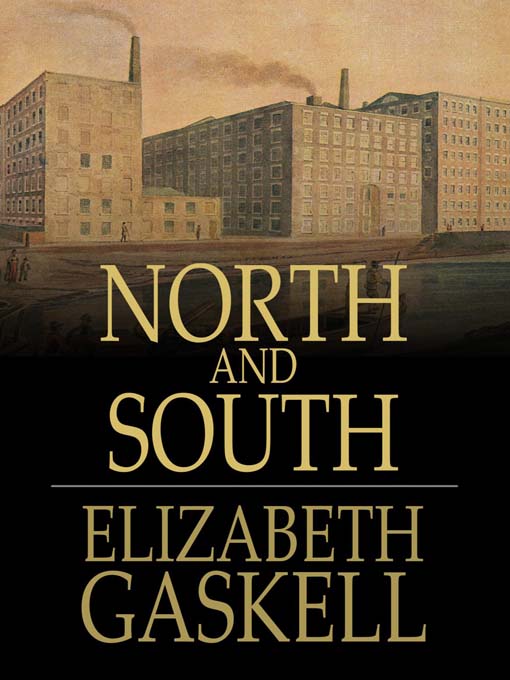
Elizabeth Gaskell (and originally published by Dickens in a weekly periodical), it's a social novel that showcases the relations between workers and their industrial masters in the fictional town of Milton in northern England (apparently inspired by Manchester where the author lived). These tense relations are seen through the eyes of the Hale family who have had to move there from Helstone in rural southern England after the father, a pastor, decides he must leave the Church of England as a matter of conscience. Following the advice of Mr Bell, a friend from his Oxford days, he moves to Milton with his wife and daughter and takes up teaching private students. It is quite a clash for the family, nowadays we'd call it culture shock. The peaceful, idyllic rural south has nothing in common with the grey, noisy, dirty northern city... even the people and their attitudes are quite different. Margaret makes friends with some of the workers and clashes with Mr John Thornton, master of Malborough Mills, who is also one of her father's students. Theirs is a clash worthy of Darcy and Elizabeth Bennett, but in this case they are both afflicted with both pride and prejudice and must overcome it before the story can come to a happy ending... ;o)
It's a story that fits well into the Industrial Revolution, a story of strife between classes (workers and masters, and the early unions and first strikes "The Union is a great power, the Union is our only power"). It does a good job of presenting the case both of the workers and the masters (dealing with the cheaper competition from America so they must lower their costs to remain competitive). As Mr Hale puts it: "I meet many a working man. They have some dreadful tales and speak
from the heart and have arguments for the strike which appear to me to
be entirely logical. (...) But then our friend Thornton (...) he answers
my questions and puts the other side so eloquently... I truly don't know
what to think!" It also shows the difference in mentality between people from the southern rural
counties and London society and the northern industrial cities.
Like most 19th century novels there are plentiful descriptions of places, people, background, society etc., and
not that much dialogue. Much of that necessary information is given to
us in the TV series either from the characters themselves during
conversations, or in the form of letters between Margaret and her cousin
Edith (whose wedding is the starting point of the story). Margaret's first letter to Edith serves as an introduction to what
life is like in Milton, her father's teaching and students, it can sometimes be
amusing when the difference between the "cheerful" tone of the letter is
in contrast with the darker reality of what's happening on screen! We get more "exposition" during a dinner among the various "masters" and Mr
Hale which illustrates Thornton's influence among his equals, and
discussions of the situation of the workers and working conditions in the cotton mills.
Although we get some of Margaret's inner thoughts via those letters (and a few conversations),
we're missing most of Thornton's thoughts on Margaret, which in the novel illustrate
how he admires her from the start (despite an inauspicious beginning in which he finds her "haughty")
and how his feelings develop, and also his sense of inferiority (due to a lack of
education, his status as he's in trade, not a "gentleman") and being
unworthy of her. But Richard Armitage does an excellent job conveying
his fascination with her and evolving feelings with the tone of his
voice and his looks and glances and his facial expressions. The
gorgeous soundtrack also helps... But because of
this we miss out on why a key moment (Leonards' death and Margaret's lies to a police officer) disturbs Thornton so
much. In the book it's clear he believes so deeply in her honourable and
truthful nature that he believes she lied to cover up for a gentleman
(with whom he saw her) who is a bad influence on her, so the belief hat she is being led astray adds to his
jealousy.
Ok, starting here I'm going to go into a more detailed comparison of book and series... so if you want to avoid spoilers you should stop reading! Instead go download the book for free from
Project Gutenberg, read it, then watch the series, and come back and tell me what you think! ;o)

.svg)